Showing posts with label s healthcare. Show all posts
Sunday, November 1, 2015
Idol White CPA - United Kingdom
http://www.lnk123.com/aff_c?offer_id=1914&aff_id=3102747dol White is endorsed by the three Kardashian Girls. Idol White is a unique teeth whitening system that’s brightened the smiles of thousands of satisfied customers. Its unique blend of natural teeth whitening ingredients brings out the natural white shade in your teeth, allowing you to get a whiter and brighter smile without the hassles or costs of most teeth whitening systems. This Offer is available only for UK.
Monday, October 26, 2015
Drug promises robust new hair growth
anew method of restoring hair growth - using drugs that are already approved for safety - may be on the way, according to research published in Science Advances.
also press on this offer ,it,s free .http://www.lnk123.com/aff_c?offer_id=1914&aff_id=310274
Researchers at Columbia University Medical Center in New York have found that when hair follicles are suspended in a resting state, rapid and robust growth can be restored by inhibiting a family of enzymes inside the follicles.
Hair follicles do not produce hair constantly but rather cycle between four resting and growing phases.
More than 90% of the hair is normally in the growing phase, "anagen," which can last from 2-6 years.
The relatively short catagen phase follows, when the follicle regresses and moves toward the surface. "Telogen" is the resting phase, and "exogen" is when the hair falls out before the follicle resumes growth.
Generally, the longer the hair, the longer the phases are; long hair tends to grow more slowly.
Enzyme inhibitors promote growth
aIn experiments with normal mouse and human hair follicles, Dr. Angela Christiano, PhD, and colleagues found that drugs that inhibit the Janus kinase (JAK) family of enzymes promote rapid and robust hair growth when directly applied to the skin.
http://www.lnk123.com/aff_c?offer_id=422&aff_id=310274
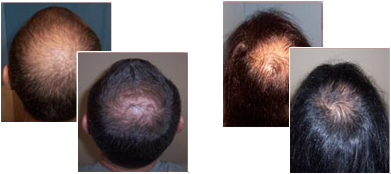
This suggests that JAK inhibitors could be used to restore hair growth in various forms of hair loss, such as that induced by male pattern baldness - also called androgenetic alopecia - and other types of hair loss that occur when hair follicles are trapped in a resting state.
Two JAK inhibitors have already been approved by the US Food and Drug Administration (FDA), one for treatment of blood diseases (ruxolitinib) and the other for rheumatoid arthritis (tofacitinib).
Both are being tested in clinical trials for the treatment of plaque psoriasis and alopecia areata, an autoimmune disease that attacks the follicles, causing hair loss.
It was while studying alopecia areata that the researchers chanced upon the effect of JAK inhibitors on hair follicles.
They had already found that JAK inhibitors shut off the signal that causes the autoimmune attack, and that oral forms of the drug restore hair growth in some people with the disorder.
Enzyme inhibitors promote strong, rapid hair growth
In experiments, the team noticed that mice grew more hair when the drug was applied topically to the skin than when given internally. This suggested JAK inhibitors might have a direct effect on hair follicles, in addition to inhibiting the immune attack.
Looking more closely at normal mouse hair follicles, they found that JAK inhibitors rapidly awakened resting follicles out of dormancy.
JAK inhibitors appear to trigger the follicles' normal reawakening process. Mice treated for 5 days with one of two JAK inhibitors sprouted new hair within 10 days, greatly accelerating the hair follicle growth phase. No hair grew on untreated control mice in the same time period.
The inhibitors also produce longer hair from human hair follicles grown in culture and on skin grafted onto mice.
In light of these findings, the researchers hope the drugs could induce new hair growth and extend the growth of existing hairs in humans.
Dr. Christiano says:
"What we've found is promising, though we haven't yet shown it is effective for male pattern baldness. More work needs to be done to test formulations of JAK inhibitors specially made for the scalp to determine whether they can induce hair growth in humans."
also press on this offer ,it,s free .http://www.lnk123.com/aff_c?offer_id=1914&aff_id=310274
Sunday, October 25, 2015
Study sheds light on body's varied response to exercise
Resistance exercise is defined as any activity that causes the skeletal muscles to contract, such as weightlifting, push-ups and squats. Endurance exercise, or aerobic exercise, is any activity that maintains an increase in heart rate and breathing, such as walking, cycling and swimming.
Both forms of exercise have a different impact on the body. While resistance exercise can improve strength of skeletal muscles, endurance exercise can improve overall functional capacity.
Because the effects of resistance and endurance exercise are so diverse, researchers speculate that there are numerous different processes involved in how the body responds to each form of physical activity.
"Yet," Kainulainen and colleagues note, "there have been attempts to identify single signaling cascades or molecules that could work as a master regulator for controlling exercise-specific adaptations."
Previous research has indicated that a gene called peroxisome proliferator-activated receptor-gamma coactivator 1α (PGC-1α) may be involved in how the body responds to certain forms of exercise. The team set out to investigate the role of this gene further in this latest study.
PGC-1α isoform production differs by type of exercise
The researchers enrolled 19 physically active men to their study and divided them into two groups. One group performed 50 minutes of endurance exercise in the form of walking on a treadmill, while the other group performed 50 minutes of leg press exercises, representing resistance activity.
Biopsies were taken from the thigh muscles of the men just before exercise, as well as 30 and 180 minutes after, which the researchers analyzed in order to assess PGC-1α activity.
The team found that both endurance and resistance exercise stimulated the PGC-1α gene, causing it to produce isoforms known as PGC-1α exon 1b, PGC-1α exon 1b' and truncated PGC-1α. Isoforms are different types of a protein that are produced from the same gene or produced from different genes if only a part of a gene's code is identified.
However, the researchers noticed that only endurance exercise triggered the production of an isoform called PGC-1α exon 1a.
What is more, the team found that endurance exercise activated genes that encouraged new blood vessel growth and increased stamina. While resistance exercise also stimulated a gene that boosted blood vess
el growth, it also activated a gene that stimulated muscle growth.http://www.lnk123.com/aff_c?offer_id=20&aff_id=310274